Introduction
When the state compulsorily acquires a citizen’s land, the question of fair compensation becomes not merely an administrative matter but a constitutional imperative. The stakes are especially high when the land in question carries a distinctive character say, an active industrial site but the authorities reach for an entirely different metric, such as a nearby residential plot sale, to fix its value. That is precisely the situation that the Supreme Court of India addressed in its landmark ruling of May 12, 2026, in Project Director, NHAI v. Alfa Remidis Ltd.
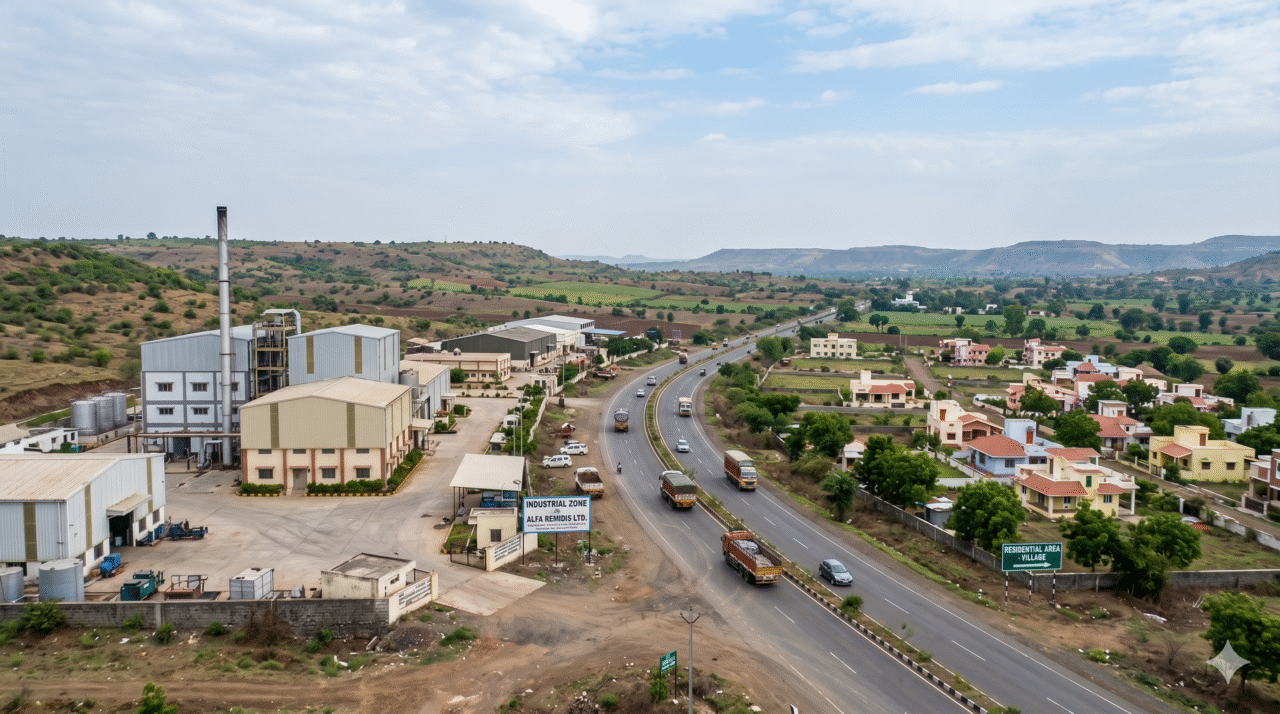
The case arose from the compulsory acquisition of land in Nagpur’s Mouza Pardi (Rithi) for the four-laning of National Highway No. 547-E. What began as a straightforward highway project quickly escalated into a complex dispute over statutory methodology, arbitral jurisdiction, and the true market value of industrial property ultimately requiring the highest court’s intervention to restore legal order.
Background and Facts
Alfa Remidis Ltd. owned 1,394 square metres of land in Nagpur District, on which it operated a paracetamol manufacturing unit. In May 2017, the National Highways Authority of India (NHAI) issued an acquisition notification for the four-laning of NH 547-E. The Deputy Collector, acting as the competent authority, classified the land as agricultural and pegged compensation at a meagre ₹161.63 per square metre a valuation based on agricultural sale deeds of the same village.
Unsatisfied, Alfa Remidis challenged this before the Arbitrator (the Additional Commissioner), presenting documentary evidence of active industrial use and two alternative valuation benchmarks: first, the government Ready Reckoner rate of ₹2,020 per square metre applicable to highway-abutting lands, and second, a registered sale deed dated March 29, 2017, for a residential plot of 195.09 square metres in the neighbouring Mouza Saoner, reflecting ₹3,588 per square metre.
The Arbitrator, accepting that the land was industrial in character, chose the higher of the two benchmarks the residential sale deed rate of ₹3,588 per square metre and issued an award accordingly in November 2021. NHAI challenged this before the District Judge under Section 34 of the Arbitration Act, which set the award aside. However, the Bombay High Court subsequently restored it under Section 37 proceedings, prompting NHAI’s appeal to the Supreme Court.
Legal Issues Before the Court
- Whether Sections 26 to 28 of the 2013 Land Acquisition Act apply to compensation under Section 3G(1) of the National Highways Act, 1956.
- Whether the Arbitrator erred in relying on a single residential sale deed from an adjoining village rather than following the mandatory methodology under Section 26(1) of the 2013 Act.
- Whether the arbitral award was vitiated by “patent illegality” warranting interference under Section 34(2A) of the Arbitration and Conciliation Act.
- What is the correct rate of compensation payable to Alfa Remidis Ltd.?
The Arguments
Appellant — NHAI
NHAI argued that the Arbitrator committed patent illegality by bypassing the mandatory methodology in Section 26(1) of the 2013 Act. The sale deed relied upon related to a small residential plot in an adjoining village clearly not "similar type of land" to an active industrial site. The Explanations to Section 26(1) require compensation to be computed from the average of multiple sale deeds over the preceding three years, making reliance on a single deed impermissible.

NHAI further pointed out that Alfa Remidis had itself placed the Ready Reckoner rate of ₹2,020 per square metre on record the applicable government rate for Zone 4 highway-abutting lands and this was the proper figure to apply under Section 26(1)(a).
Respondent — Alfa Remidis Ltd.
Alfa Remidis maintained that its land had been wrongly classified as agricultural when it was actively used for pharmaceutical manufacturing. The comparable sale deed of March 2017 was a genuine, registered transaction for non-agricultural land from a nearby village and was the most reliable benchmark available, with no objection raised to its authenticity before the Arbitrator.

The respondent also urged that the scope of interference with an arbitral award under Sections 34 and 37 of the Arbitration Act is extremely narrow, and the High Court was correct in restoring the award.
The Supreme Court’s Analysis
The Court first settled the threshold question by affirming — following its earlier precedent in NHAI v. P. Nagaraju (2022) 15 SCC 1 that Sections 26 to 28 of the 2013 Land Acquisition Act are fully applicable to compensation determination under Section 3G(1) of the National Highways Act. This point was no longer seriously in dispute.
The more substantive question concerned the Arbitrator’s reliance on the single residential sale deed. The Court was categorical: the two parcels of land one a residential plot, the other an active industrial site were simply not of a “similar type” as mandated by Section 26(1)(b). The residential plot in an adjoining village bore no meaningful resemblance to a pharmaceutical manufacturing unit, and the price it fetched in the open market could not serve as a benchmark for the latter’s value.
The Arbitrator demonstrably erred in relying upon the sale deed dated 29.03.2017 relating to residential land in an adjoining village to determine the market value of respondent No.1’s land, which was being used for an industrial purpose. Clearly, the two lands were not of a ‘similar type’ for the purposes of Section 26(1)(b) of the 2013 LA Act and the price in the said sale deed could not have been adopted. — Justice Sanjay Kumar & Justice K. Vinod Chandran, 2026 INSC 480
The Court went further, emphasising that the methodology prescribed for computing “average sale price” under the Explanations to Section 26(1)(b) requires multiple sale deeds, not a solitary transaction. This principle had been previously affirmed in Madhya Pradesh Road Development Corporation v. Vincent Daniel (2025) 7 SCC 798, where the Court held that a single transaction may not accurately reflect prevailing market values, and that reliable compensation demands a broader, averaged dataset.
The disregard of these statutory directions was not a mere error of law but a fundamental departure from the legislative framework constituting patent illegality on the face of the award under Section 34(2A) of the Arbitration Act. Critically, the Court held that the protective proviso in Section 34(2A), which shields awards from interference for mere erroneous application of law, cannot extend to cover such a fundamental statutory violation. The High Court’s restoration of the award was accordingly erroneous.
The Verdict — Compensation Reassessed
Rejecting the residential sale deed benchmark of ₹3,588 per square metre, the Supreme Court turned to the Ready Reckoner rate a figure that Alfa Remidis itself had placed on record as the appropriate basis for compensation. The Ready Reckoner rate for Zone 4 (which includes Mouza Pardi Rithi) covering highway-abutting lands was:
Compensation was accordingly fixed at this rate for the entire acquired extent of 1,394 square metres, and the landowner was declared entitled to all consequential statutory benefits under the 2013 Act. The ₹50,00,000 already withdrawn by Alfa Remidis was directed to be adjusted against the balance compensation payable.
Significance of the Ruling
This judgment is significant on at least three levels. First, it reinforces the non-negotiable character of the valuation methodology under Section 26(1) of the 2013 Act. Compensation cannot be determined on the basis of whichever comparator yields a higher figure the comparator must be legally appropriate, reflecting sales of land of a similar nature and use.
Second, the ruling clarifies the interaction between arbitration law and land acquisition law. The protection afforded to arbitral awards under the narrow grounds of Section 34 of the Arbitration Act does not create a safe harbour for awards that openly contravene statutory mandates. Where an arbitrator ignores the directives of an applicable statute, the resulting award is not merely debatable it is patently illegal.
Third, the outcome strikes a notable balance: while the Court firmly rejected the inflated compensation figure of ₹3,588 per square metre based on an improper comparator, it did not leave the landowner without redress. By anchoring compensation to the Ready Reckoner rate of ₹2,020 per square metre itself a figure placed on record by the landowner the Court ensured that the acquisition authority’s strikingly low original valuation of ₹161.63 per square metre was also not restored.
For practitioners, land acquisition authorities, and arbitrators, the message is clear: when determining compensation for acquired land, the nature and use of the land being acquired must be matched against genuinely comparable transactions. An industrial plot and a residential plot are not comparable, however close they may be geographically. The law demands like-for-like and the Supreme Court has now made that demand unmistakably firm.
Conclusion
In Project Director, NHAI v. Alfa Remidis Ltd., the Supreme Court has done more than decide a compensation dispute it has drawn a clear jurisprudential line between legitimate valuation and statutory shortcut. The 2013 Land Acquisition Act’s insistence on “similar type of land” is not a technicality to be bypassed in pursuit of a higher award; it is the cornerstone of a fair and principled compensation framework. By setting aside an inflated arbitral award rooted in an impermissible comparator and recalibrating compensation to the government-notified Ready Reckoner rate, the Court has upheld both the letter and spirit of the law.
As infrastructure development continues to drive large-scale land acquisition across India, this ruling will serve as an important guardrail ensuring that those deprived of their land are compensated fairly, but that the methodology of fairness itself remains legally sound.