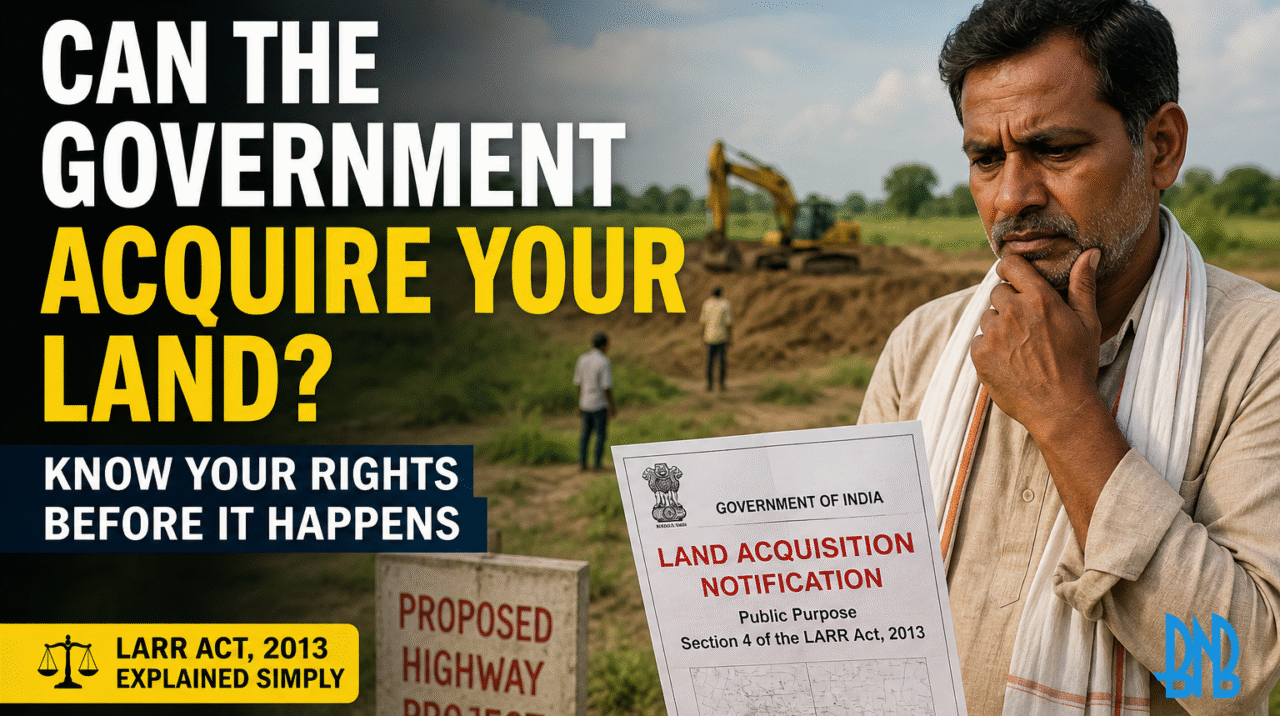
It is a quiet Sunday morning in a village. Farmers are preparing their fields for the next crop, children are playing near the village pond and life is moving at its usual pace. By afternoon, a rumour begins to spread: government officials have been seen inspecting land on the outskirts of the village. Someone says a new highway is being planned. Another person mentions an industrial project. Within a few hours, every conversation revolves around the same question:
“Will Our Land Be Acquired?”
For some villagers, the news brings optimism. Better roads could improve access to markets, hospitals, schools and employment opportunities. New industries may create jobs and contribute to regional development.
For others, however, the announcement brings uncertainty. The land they cultivate is not merely an asset recorded in revenue records. It is their home, their livelihood, their identity and often a legacy passed down through generations. The thought of losing it raises genuine concerns about the future.
As discussions continue, questions begin to surface.
-
Can the Government acquire private land?
-
Can land be acquired without informing the owner?
-
How is compensation determined?
-
What happens to families whose homes or livelihoods are affected?
-
Can people object to the acquisition?
These are not just legal questions. They are questions that thousands of families across India ask whenever a public project requires land.
Development and Individual Rights Must Go Together
Every growing nation requires land to build infrastructure and create public assets. Roads, railways, airports, irrigation canals, schools, hospitals, renewable energy parks, mining projects, industrial corridors and public utilities all require land. Without land, development cannot take place.
At the same time, land is unlike any other asset. For many families, it is the primary source of livelihood, financial security, social identity and emotional attachment. Acquiring land, therefore, is never merely an administrative exercise. It directly affects people’s lives.
A modern legal system must therefore achieve two equally important objectives. It must enable projects that serve a genuine public purpose while ensuring that people whose land or livelihoods are affected are treated fairly, transparently and with dignity.
This is the philosophy behind the Right to Fair Compensation and Transparency in Land Acquisition, Rehabilitation and Resettlement Act, 2013, commonly known as the LARR Act, 2013.
So, Can the Government Acquire Your Land?
The answer is yes, but only in accordance with the law.
The Government cannot simply decide to acquire private land without following the legal process prescribed under the applicable legislation. The LARR Act establishes a structured framework that sets out how land acquisition should take place, how compensation is determined and what safeguards exist for affected families.
The Act recognizes that while development is necessary, it must not come at the cost of fairness or transparency. It seeks to ensure that acquisition is carried out through a legal process rather than through arbitrary decision-making.
The Three Pillars of the LARR Act
Although the Act contains numerous chapters and detailed procedures, its purpose can be understood through three fundamental principles.
1. Fair Compensation
One of the central objectives of the Act is to ensure that compensation is determined in accordance with the law rather than through arbitrary assessment. Depending on the circumstances of each case, compensation may include not only the value of the land but also eligible compensation for structures, standing crops, trees and other attached assets.
2. Transparency
People have a right to know how and why land is being acquired. The Act provides for statutory procedures that include notifications, surveys, publication of information and other prescribed steps intended to make the acquisition process transparent and accountable. Transparency helps reduce uncertainty and builds public confidence.
3. Rehabilitation and Resettlement
The impact of land acquisition often extends beyond the loss of property. Families may lose their homes, livelihoods, or access to community resources. Recognizing this reality, the Act includes provisions for rehabilitation and resettlement benefits for eligible affected families, acknowledging that compensation alone may not always address the consequences of displacement.
Why Understanding the Law Matters
Whenever a major project is announced, rumours often spread much faster than reliable information. Some people believe that compensation is entirely discretionary. Others assume they have no rights once officials begin surveys. Still others think that land acquisition happens overnight.
In reality, the legal framework is far more structured than many people realize. Understanding that framework helps citizens distinguish between rumours and legal facts, ask informed questions and participate more effectively in the acquisition process.
Knowledge of the law does not create conflict. It creates clarity.
Beginning a New Journey
This article marks the beginning of a new educational series titled “LARR Act 2013 Explained Simply.”
The objective of this series is not to reproduce legal provisions or use complicated legal language. Instead, it is to explain the Act in a way that every citizen can understand, whether they are a farmer, landowner, student, government official, project developer, consultant, researcher or simply someone interested in understanding how land acquisition works in India.
In every article, BNB will take one important question and explain it through practical examples, simple language and the relevant legal provisions. We will also explore common misconceptions, frequently asked questions and real-world situations that people encounter during the land acquisition process.
To understand the LARR Act, we must first understand the history that led to its enactment. Only then can we appreciate why the law emphasises fairness, transparency and rehabilitation alongside development.
That will be the subject of our next article.
Knowledge of the law empowers citizens. When people understand their rights and responsibilities, they can engage with development projects more confidently and constructively. That is the objective of this series.