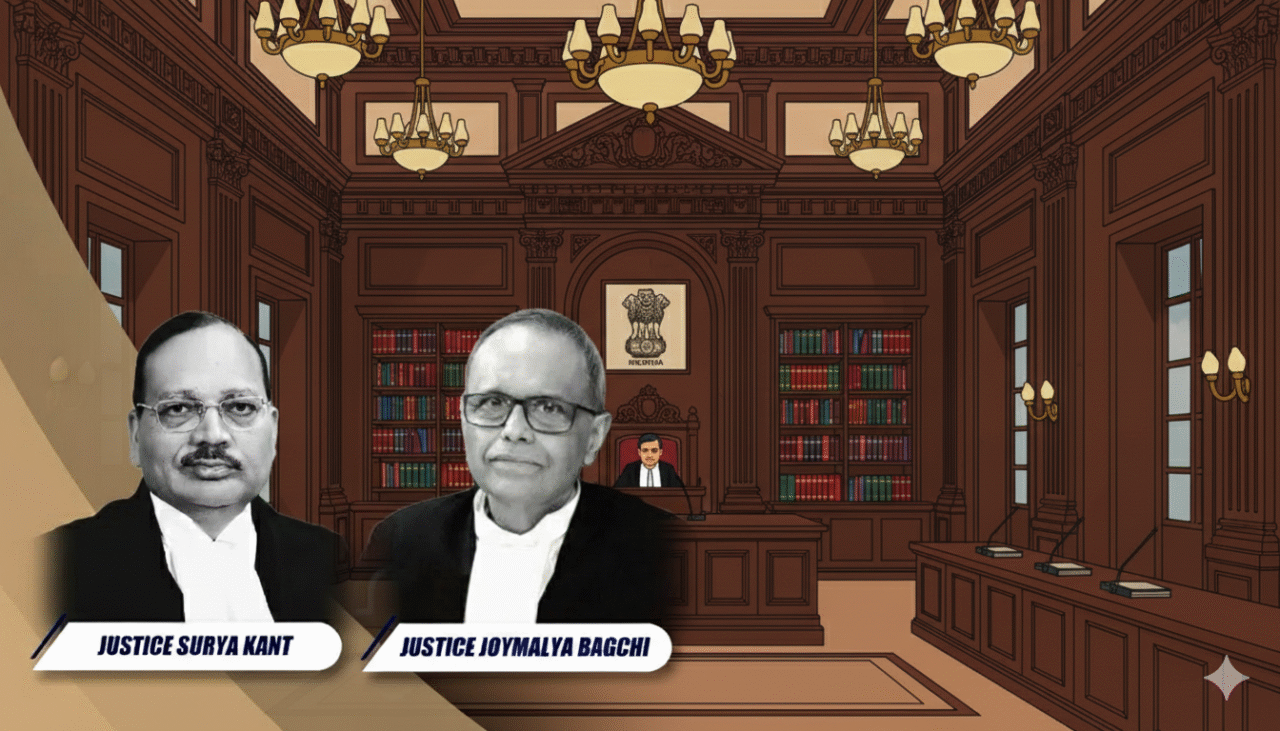
In a significant ruling clarifying the scope of relief in land acquisition disputes, the Supreme Court of India ruled that commercial entities cannot challenge an acquisition after having accepted the awarded compensation without protest.
The apex court, while hearing an appeal filed by the State of West Bengal, set aside a Calcutta High Court order that had directed the restoration of acquired land to M/s Santi Ceramics Pvt. Ltd., an industrial entity in Singur, West Bengal.
The ruling draws a sharp line between socially targeted remedies meant for disadvantaged communities and claims filed by financially capable commercial enterprises.
Restoration Not for ‘Passive Opportunism’
A division bench of Justices Surya Kant and Joymalya Bagchi made it clear that the restoration of land, ordered by the Court in 2016 in the landmark Kedar Nath Yadav vs State of West Bengal case, was a measure intended solely for the disadvantaged farming communities who lost their sole means of livelihood due to the acquisition for the defunct Tata Motors’ Nano car project.
“Relief conceived to prevent impoverishment among the disadvantaged cannot extend to commercial enterprises with financial capacity and institutional sophistication,” the bench observed.
The court emphasized the “fundamental principle that legal benefits flow from active pursuit of remedies, not passive opportunism.”
The Case of Santi Ceramics
The Singur land acquisition, which began in 2006, included a 28-bigha plot owned by Santi Ceramics, a ceramic manufacturing unit. When the acquisition was finalized, the company accepted the entire compensation amount of approximately ₹14.54 crore without raising any protest and chose not to pursue appellate remedies available under the Land Acquisition Act, 1894, for over a decade.
Following the Supreme Court’s 2016 verdict—which quashed the acquisition proceedings citing procedural violations and disproportionate harm to poor cultivators—Santi Ceramics sought the same relief, claiming restoration of its land.
The Supreme Court rejected this claim, noting that the company’s action of accepting the monetary settlement without challenge and remaining passive during the years of farmer-led litigation amounted to a clear act of acquiescence and waiver.
“Having chosen not to contest the acquisition through available statutory mechanisms, [the company] now seeks the same relief that was granted to disadvantaged communities through PIL—a classic free-rider problem that judicial remedies cannot encourage,” the bench stated.
Judgement Upholds Finality of Acquisition
The verdict reinforces the legal principle that acceptance of compensation typically finalizes the acquisition process for the recipient. The court stressed that the 2016 quashing of the acquisition proceedings applied in personam (to those who challenged the acquisition) and not in rem (against the world at large), specifically for entities that had forgone their right to challenge.
Regarding the company’s existing structures on the land, the court granted limited relief, permitting Santi Ceramics to remove its remaining structures and machinery from the subject land within three months. Alternatively, the company may request the State authorities to conduct a public auction of the assets.
The judgement is expected to have a far-reaching impact, mandating that industrial entities must actively pursue statutory or legal remedies to contest land acquisition rather than relying on future litigation successes achieved by others.